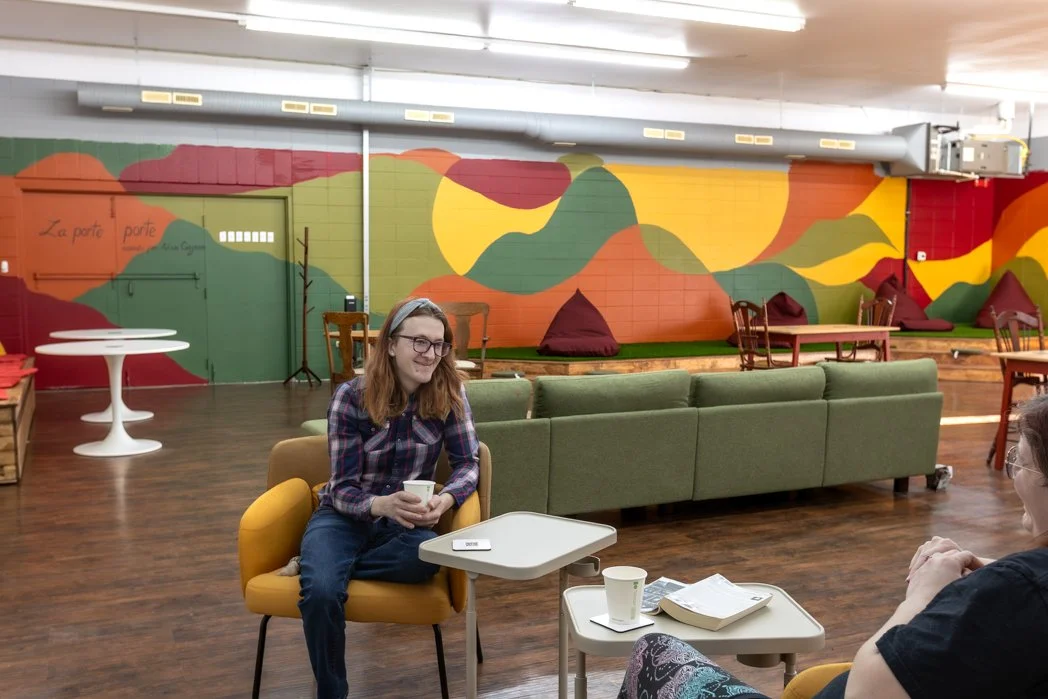
The following article was written by Julie Dunleavy, Program Director at FES
Disclaimer: This blog post was written in both English and French throughout, without translation of all words in both languages, to respect the spirit of the article. The reader is encouraged to use translation websites such as DeepL if they require further understanding.
Avertissement : Cet article de blogue a été rédigé entièrement en anglais et en français, sans que tous les mots aient été traduits dans les deux langues, afin de respecter l'esprit du texte. On t'invite à utiliser des sites de traduction comme DeepL si vous avez besoin d'aide pour mieux comprendre.
It’s not often that I get the chance to see a project from The Youth Harbour in real life, in-person. During my time at FES, I have happily supported the back-end of the youth-led climate movement: coaching calls, coffee chats, check-ins, administrative tasks… even meeting with collaborators at conference, networking, and community events. These moments of connection are extremely special; however, due to the nature of our work as enablers within this space, these opportunities for connection are few and far between.
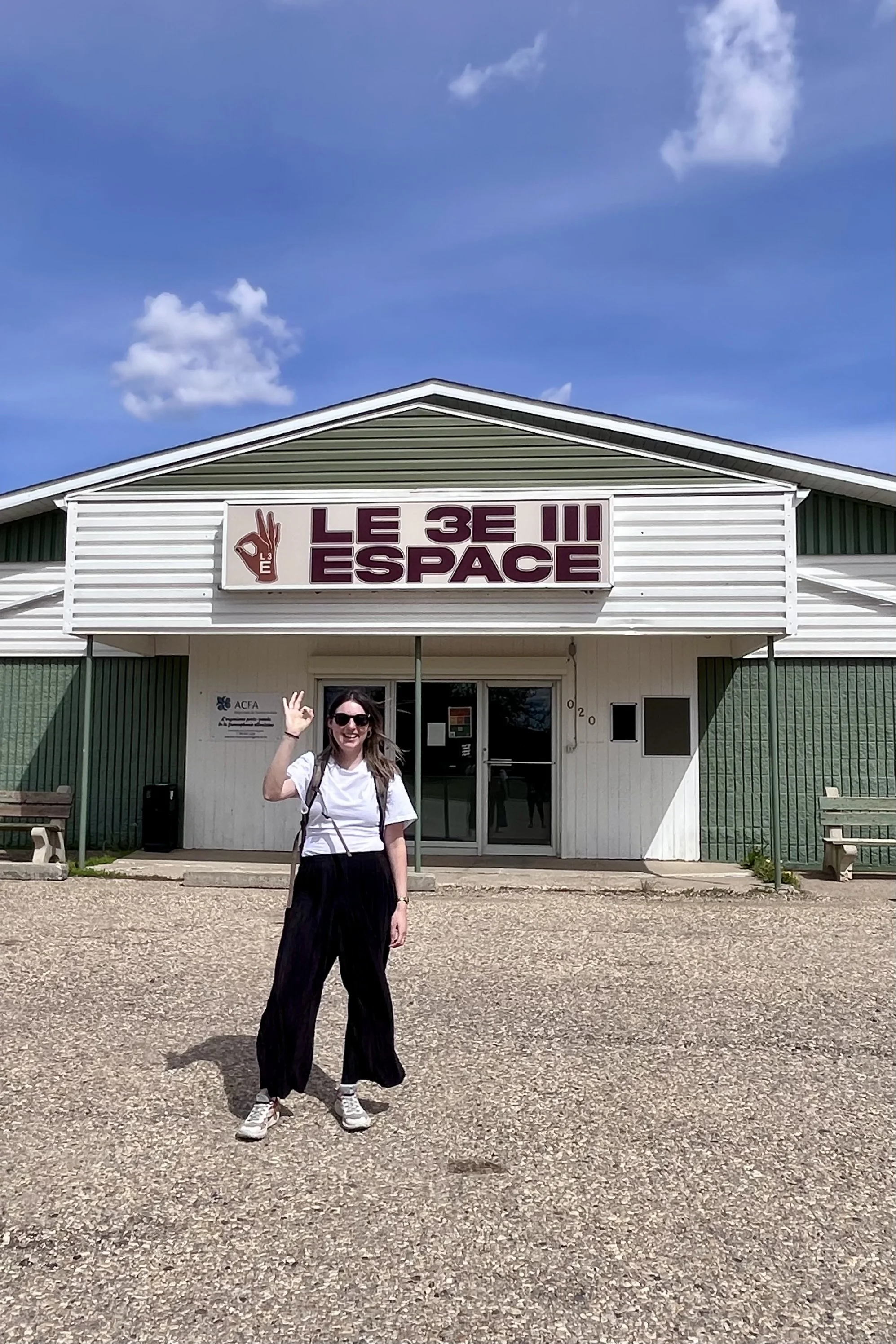
While recently visiting Alberta, however, I had the opportunity to travel a little more north than usual. It was during this visit that I was welcomed into a third space. More specifically, Falher Alberta’s Le 3e espace. En plus, je me sentais bienvenue dans une petite ville bilingue dans une province où beaucoup de monde ne s'associe ni à la langue française, ni au bilinguisme. Même les signes d'arrêt était écrit comme “Stop | Arrêt” et les gens ont switché entre les deux langues facilement.
I love this way of communicating, not only because French is my second language, and sometimes I do search for my words, but because it also invites a beautiful blend of culture and contexts within distinct communities across our country. What we know as “Canada” is home to dozens of Indigenous languages, as well as hundreds of other languages from the multitude of cultures, subcultures and communities that exist across these lands. While French and English are Canada’s two official languages, they are seldom equally represented, and they can never tell the full story; however, I personally find any story more interesting when multiple languages are blended in to narrate it.
The story I want to tell is from an outsider’s perspective; of me as a visitor in the town of Falher for just a few days. Chúk Odenigbo is the founder of Le 3e espace; which builds on the concept of a “third place”. The concept is simple: the first place is one’s home; the second place is one’s workplace; and thus, the third space is distinct from the first and second, in that it is a casual and social setting for human beings to connect. Chúk noticed there was a lack of convening space in his community, and so, he started one. Social movements and progress towards sustainability are hard to come by if there is nowhere to ideate, create, and convene, especially in rural, remote and northern areas.
It was clear to me immediately that although isolated, Falher is a thriving community. It’s walkable within its bounds, it’s proud of its history and culture, and the main thing I noticed is that everyone in Falher is a doer. From the students I met at the local high school to the older adults leading the local radio station, everyone had more than one project on the go that contributed to art, events, or services for their community. While technology was readily accessible, it didn’t feel like there was an overreliance on it. Ideas were shaped when crossing paths with other community members, not necessarily through online advocacy or organizing that we often see in urban centres. After just one day, I had met many community members for the first time, and was already invited to their community events that same weekend.
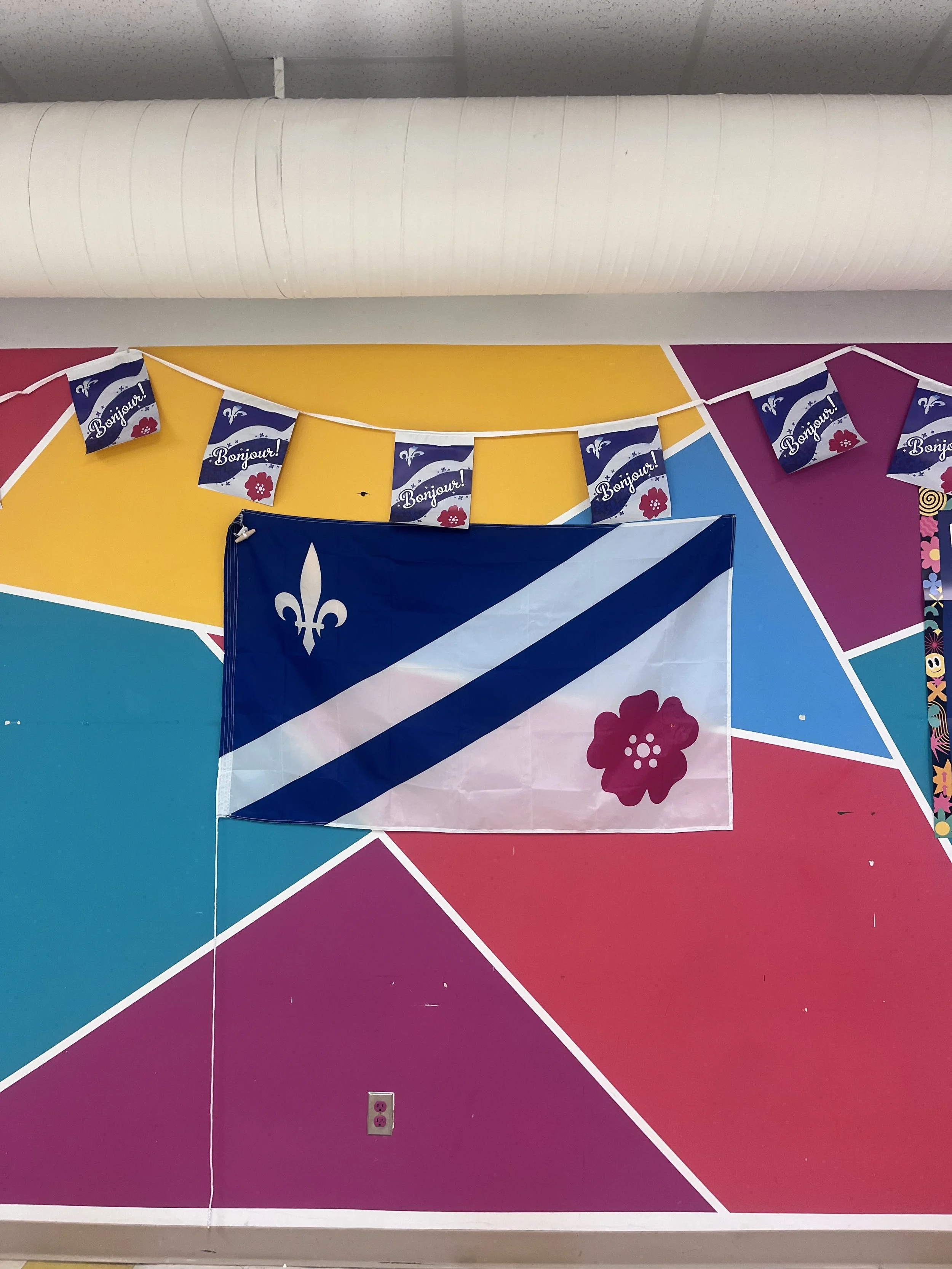
Le 3e espace était clairement mis en place pour une raison concrète: avoir une place hors des écoles, des églises, des restaurants et des centres communautaires pour se reposer, travailler, chiller et créer des idées ensemble. J’ai vu comment cet espace a déjà créé un “home base” pour tout le monde, et comment ça peut encore plus ancrer les gens qui habitent à Falher et dans la région de la Rivière-la-Paix. Le sens du bilinguisme est aussi tellement important dans cette région, qui est souvent oubliée comme partie du Franco-Canada. J’ai vu comment les personnes franco-albertaines étaient tellement fières de leur culture et de leur langue, et ça doit être protégé.
Les langues qu'on parlent influencent les façons dont on voit et on interagit avec le monde qui nous entoure, et par conséquent, la façon dont on vit et on lutte contre les changements climatiques. Existing and expressing in multiple languages often enables a deeper connection with nature on an individual level, and ideally, can turn into widespread environmental action. Ce qu’il faut faire pour l’action environnementale dans une ville urbaine et anglophone ne peut pas être le même que dans une ville rurale et francophone, par exemple. Cependant, entre cette dualité existent des complexités de l’environnement actuel, les détails pertinents, et alors, les solutions pour la durabilité.
I may never fully understand the contextual challenges and joys of living in a town like Falher, but I don’t necessarily need to. I’m merely a visitor, who was welcomed and received with open arms. But community members always have, and always will produce their own solutions. They need to be recognized, believed in, and supported in the context that works best for them. It was incredible to see one of our projects in motion, and even more special that this project happened to manifest itself into a physical space. In this case, the physical space was needed, and the community literally painted, built and fabricated the space as it is today. What’s next for Falher, like any community, is unknown to me, but what I do know is that they know exactly where to find each other.